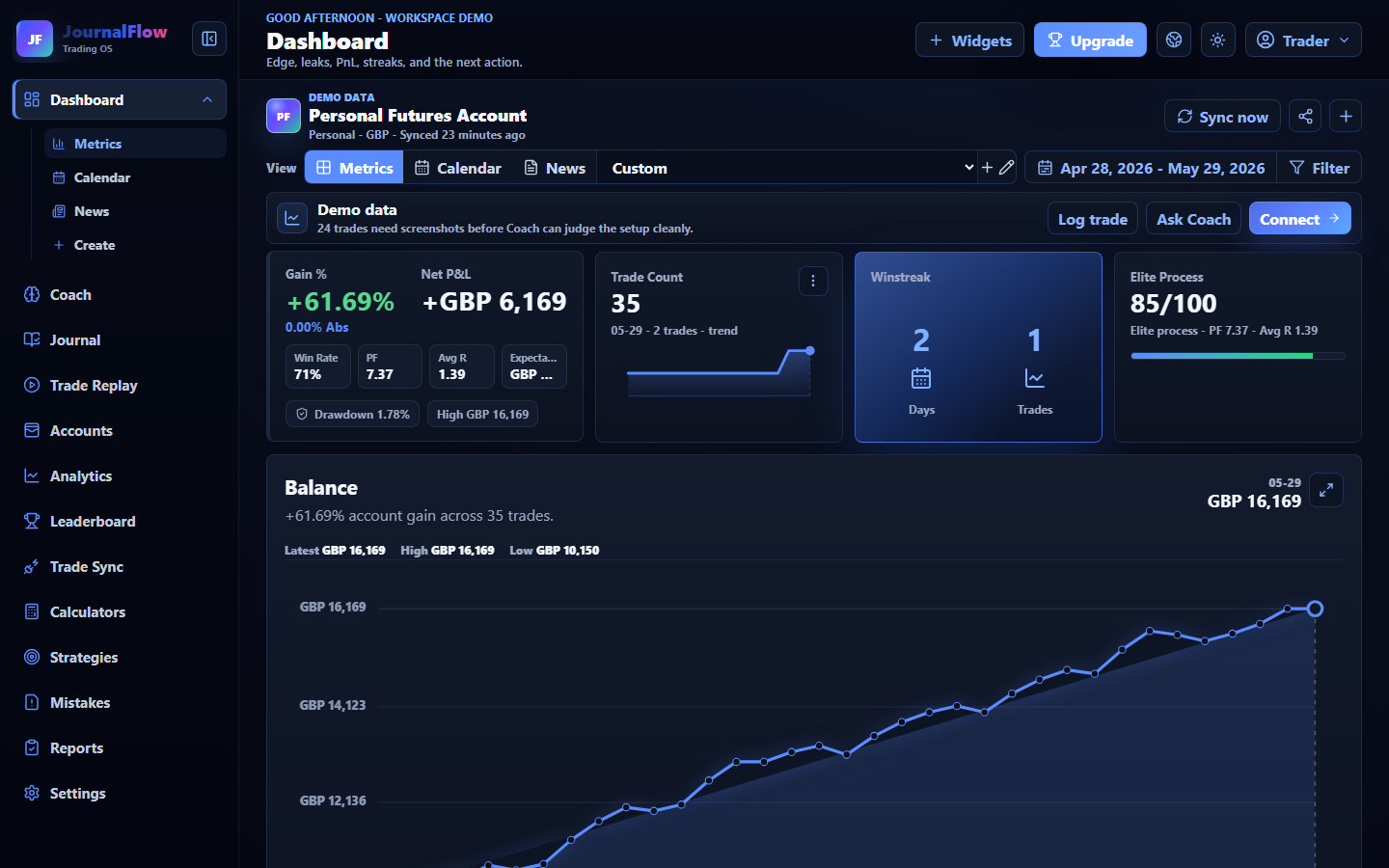
Futures traders often need a faster review loop than swing traders. One bad New York AM session can change the whole week. The journal has to show session behaviour, contract risk, account rules, and mistake cost quickly.
Build the journal around sessions
For many futures traders, the same setup behaves differently across London, New York AM, New York PM, and news windows. Session tags make the review practical.
- Track session, time of day, and news proximity
- Compare ORB, liquidity sweep, continuation, and reversal setups by session
- Spot when the trader should stop instead of forcing another trade
Track contract risk and fees
Futures traders should know whether contract size, commissions, and slippage are changing the real edge. A strategy can look fine before costs and weak after costs.
- Record market, contract, position size, and risk per trade
- Track realised RR and account currency result
- Review fees and overtrading together
Keep funded-account rules beside the trade
A futures journal is more useful when it shows daily loss, max drawdown, consistency pressure, payout protection, and whether the next trade is worth the rule risk.
- Separate personal, challenge, funded, and demo accounts
- Review daily loss before taking another trade
- Use the journal to decide when to reduce size or stop